
Colombian emerald fever hits TikTok: A journey to Muzo, the source of the world’s most valuable gems
The people of Boyacá, in central Colombia, still bear the stigma of the so-called ‘green wars’ that ended with a peace agreement in 1990. The town has distanced itself from the crimes linked to the precious stone trade, and these days a group of miners and artisans are exploring their business through social media while promoting tourism in the region
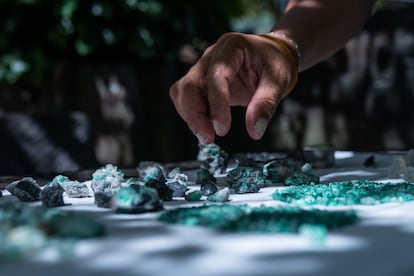

In Muzo, luck and chance are like two more neighbors in town — old, familiar faces. People buy and sell raffles, lottery tickets, or betting slips in the hope of a stroke of fortune that might change their lives. But this corner of Boyacá, in central Colombia, is best known for a more enchanted version of luck: emeralds, the most valuable in the world.
The relentless pursuit and improbable discovery of emeralds have defined life here since the days when only Indigenous peoples inhabited the land. Although greed for the gems once sparked violent conflicts that bled the region dry, today there’s a sense of peace and a notable shift in the air: the emerald trade, which used to happen in person to verify the stones’ value, is now conducted via TikTok and social media. The business of the green treasure in this self-proclaimed emerald world capital no longer works the way it used to.
Muzo is a hot, rural town of just over 9,000 inhabitants, located about 111 miles from Bogotá. To get there, you have to travel along a rugged dirt road with sections where you have to cross small streams and climb steep hills that often prove too challenging for smaller vehicles. The town is nestled between lush green mountains. Atop one of them stands a statue of Christ with arms outstretched in a cross, overlooking the landscape. Just beneath it, visible from several miles away, are giant letters bearing a message that reads like both a reminder and a warning— an antidote to the latent violence of the past: “Peace. God sees all.”
That sign has been there since the emerald miners signed a peace agreement following the last of the so-called green wars, in 1990. Before that, working with emeralds was practically a death sentence. Locals in Muzo say it’s the only peace accord in Colombia that has truly worked. The town’s calm atmosphere seems to support that claim: here, everyone carries emeralds as if they were pocket change, offering them casually on bar tables or public benches. It’s more unusual to find someone who isn’t wearing jewelry inlaid with the green stone that has shaped the history of western Boyacá.
Muzo is the heart of an emerald-producing region that also includes towns like Otanche, San Pablo de Borbur, Maripí, Pauna, La Victoria, and Quípama. From this land came Fura and Tena, two of the most famous gems in the world. Also from Colombia — specifically Gachalá, in the department of Cundinamarca — came the emerald known as Emilia, named after the woman who, according to local lore, unknowingly used it as a doorstop. Stories like these are part of why Colombian emeralds have a global reputation and make a major contribution to the country’s economy. According to the Colombian Emerald Federation, in 2024, exports of the gem — which account for 97% of national production — reached $162.1 million.
In the emerald heart of the world, it’s common for people to wear knee-high black rubber boots. With these, they cross streams, trudge through mud, and work in the mines keeping their feet free from dirt and moisture. Josué González, a 24-year-old miner proud of his town, usually dresses with these boots, a poncho, and a hat. He’s open about his life on Instagram and TikTok. On social media, he created a name for himself by which he is also known in the streets of his town: Guaquerito. With over 51,400 followers across both accounts, González is one of Muzo’s first emerald influencers.
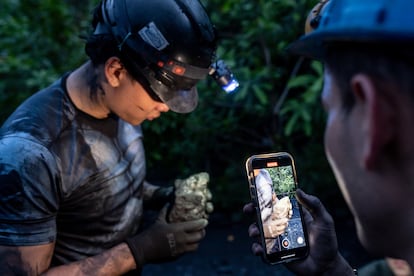
Guaquerito’s loquacity is one of the driving forces behind his social media profiles. Another is his relatable way of describing the daily routines of Boyacá miners searching for hidden emeralds. He works at the Coscuez mine near Otanche, and invented a program called “Guaqueritos for a Day,” inviting his followers to visit the region and step in the role of a miner. He always underscores one point: the conflicts in western Boyacá are a thing of the past. The violence associated with the precious stone seems at times to have moved to Bogotá, where, last year, emerald entrepreneurs Juan Sebastián Aguilar, alias Pedro Pechuga, and Hernando Sánchez were killed by snipers.
Guaquerito’s proposal appealed to Candy Nocua and José Gregorio Sánchez, who, along with three of their four children, arrived in Muzo after a 10-hour road trip from Bucaramanga. They ordered lunch at a restaurant: a selection of beef and pork with potatoes and yucca, guarapo (a fermented beverage), refajo (a beer mixed with cola), and some beer. That’s how they prepared for the most exciting and demanding part of Guaquerito’s program: entering the depths of one of the emerald mines and waiting for luck — also present in these hills — to reveal itself as a bright green gem amid the black earth.
Hidden riches
The people of Muzo sometimes tell a story that speaks to the richness of their land: long ago, two men were trying to catch an armadillo — whose meat is a local delicacy. The frightened animal began digging into the earth to take shelter, and as it dug its burrow, emeralds started to emerge from the soil. This tale is likely part of local folklore, but one thing is certain: the gems no longer surface so easily. Nowadays, people sift through earth discarded decades ago, hoping to find a stone that will change their lives.
Lady Fajardo, 26, explains — shovel in hand and water halfway up her boots — how the job of “palear” works: you place a medium-sized stone in the stream running down the mountain to create a kind of cradle at the bottom where stones accumulate. From that cradle, you scoop earth with the shovel, spread it on a dry surface, and dig through it looking for an emerald. This method is done in the open air, at the bottom of the abyss created by the mountains. It’s also part of the tourist tours she offers on her TikTok profiles, where she sells emeralds across the country. Her social media name is @Esmeralady, and her videos have reached 42,000 views.
Since arriving in Muzo seven years ago, Lady has been immersed in the mining world. Six months ago, at the suggestion of a friend, she started selling emeralds on TikTok. Her first livestreams were so successful that she decided to dedicate herself to selling jewelry and gems on social media. About four months later, she added tours of the mining areas in Muzo to her offerings, after realizing how curious people were — fascinated by her work in such a physically demanding trade as mining, which until recently was forbidden to women: the belief was that emeralds would hide if a woman tried to search for them.
Aside from her work with emeralds, Fajardo leads the community action board of the hamlet La 14. From this position, she critically observes the operations of Esmeraldas Mining Services (EMS), the major company in charge of exploiting the Puerto Arturo mine in Muzo, which covers 55 hectares with five drill sites between 90 and 150 meters deep. She acknowledges that the company can bring benefits to the region but laments the little interest it seems to have in giving back to the community.
Until June 2018, EMS was called Minería Texas Company (MTC). The company is part of the Compañías Muzo group, whose annual production usually reaches around 600,000 carats — although in 2021, EMS exceeded one million. In 2024, EMS reported profits over 120 billion Colombian pesos ($30 million), according to data provided to the Bogotá Chamber of Commerce. From its mines come enormous gems that, locals say, for security reasons are not transported by car out of Muzo but by helicopter. In any case, whether by road or air, EMS doesn’t need TikTok.
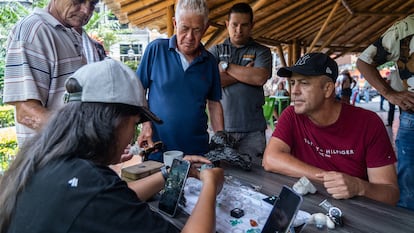
In the town center the next day, Lady prepares an order of several emeralds, each smaller than a fingernail, with certificates of authenticity, to be sent to Palmira in the Valle del Cauca. At the table next to hers, a merchant named Walter has set up shop. He wears a white poncho and has laid out small piles of rough emeralds of various qualities and sizes. In just a few minutes, several people come and go, asking about the stones, inspecting them, and haggling. Some have magnifying glasses hanging around their necks to study the gems in detail.
Not far away sits Alessandro Durante, a 50-year-old Italian who travels the world searching for all kinds of precious stones. He learned about Guaquerito after watching a YouTube video while in Bogotá and reached out to him to guide his visit to Muzo. For the past 10 years, Alessandro has been fully immersed in the gem business, living an itinerant lifestyle: in the last year, he spent less than a month in Rome, his home city. He also took part in one of Lady’s tours. Sitting at a bar terrace table, wearing sunglasses, he orders a beer to cool off from the heat as he talks.
—How long have you known about the fame of Colombian emeralds?
—Always.
—Why didn’t you come before?
—Because I knew they had problems before. And here in Colombia, emeralds are also very expensive. The color of the ones we have here can’t be found anywhere else in the world, but there are some countries like Zambia, Pakistan, or Afghanistan that have good emeralds at a reasonable price.
—So you think they’re very expensive here...
—A little, yes. But I’m looking now, because I might find something to buy at a fair price.
—And the idea is to buy here and sell in Europe…
—That’s it, of course.
Just a few meters away, on a bench waiting for someone to sit beside it, is the statue of a man with a mustache, a hat, and an emerald in his hand. He is not identified by name, but bears a clear resemblance to Víctor Carranza, the archetype of the millionaire emerald miner. Known as the “Emerald Czar,” he ruled this land for decades and amassed a fortune that brought enemies, intrigues, and violence. He was accused of forming paramilitary groups but died in 2013 of cancer, without any active legal proceedings against him, owning vast stretches of land and with his bank accounts full. His memory is still very much alive in Muzo.
References to Carranza often come up in conversations — at this hotel, in that shop. One such place is Pablo Vanegas’ store. A Bogotá native, 65 years old, he has lived in Muzo for 50 years. A photo of him alongside the Czar is visible as you enter his shop. His business is the only one from which a beam of light shines late at night, just a few meters from Carranza’s anonymous statue. He works well into the early morning, alongside seven employees. There’s a reason for these hours: it’s the time of day when he gets the most visitors to his live TikTok streams, where he raffles and auctions off his emerald crafts to people all over the country. He hopes to soon expand that to the whole world, once he can be sure the merchandise will reach other countries without any problems.
His social media adventure began five months ago. Before that, he was solely focused on running his shop and workshop. A skeptic of new technologies, he finally gave in after persistent encouragement from his friends. He invited a local TikToker to do a livestream from his store, and the success was immediate: “It’s like having the shop full of tourists, walking by and asking questions — it’s practically the same,” he says. In less than six months, his TikTok profile, @Tiendarte_muzo, gained over 5,500 followers, and each livestream attracts at least 15 to 20 foreigners. The enthusiasm with which he shares his whole process, so quickly achieved, reflects the spirit of the new wave of emerald sales in Muzo.
In the heart of the emerald land
But not everyone has overcome their skepticism. Some dismiss TikTokers as nothing more than fame seekers. That’s what a miner at the entrance of the Las Carmas mine says, where the family from Bucaramanga has arrived for their tour. The entrance here is nothing like the concrete tunnels of the multinational mines. Instead, it’s a hole less than two meters high and just as wide. Inside, without a flashlight, there’s no difference between keeping your eyes open or closed. Lady has also joined the tour — she recognized the familiar voice of Don Gregorio Sánchez right away. It turns out he has bought emeralds from her on TikTok.
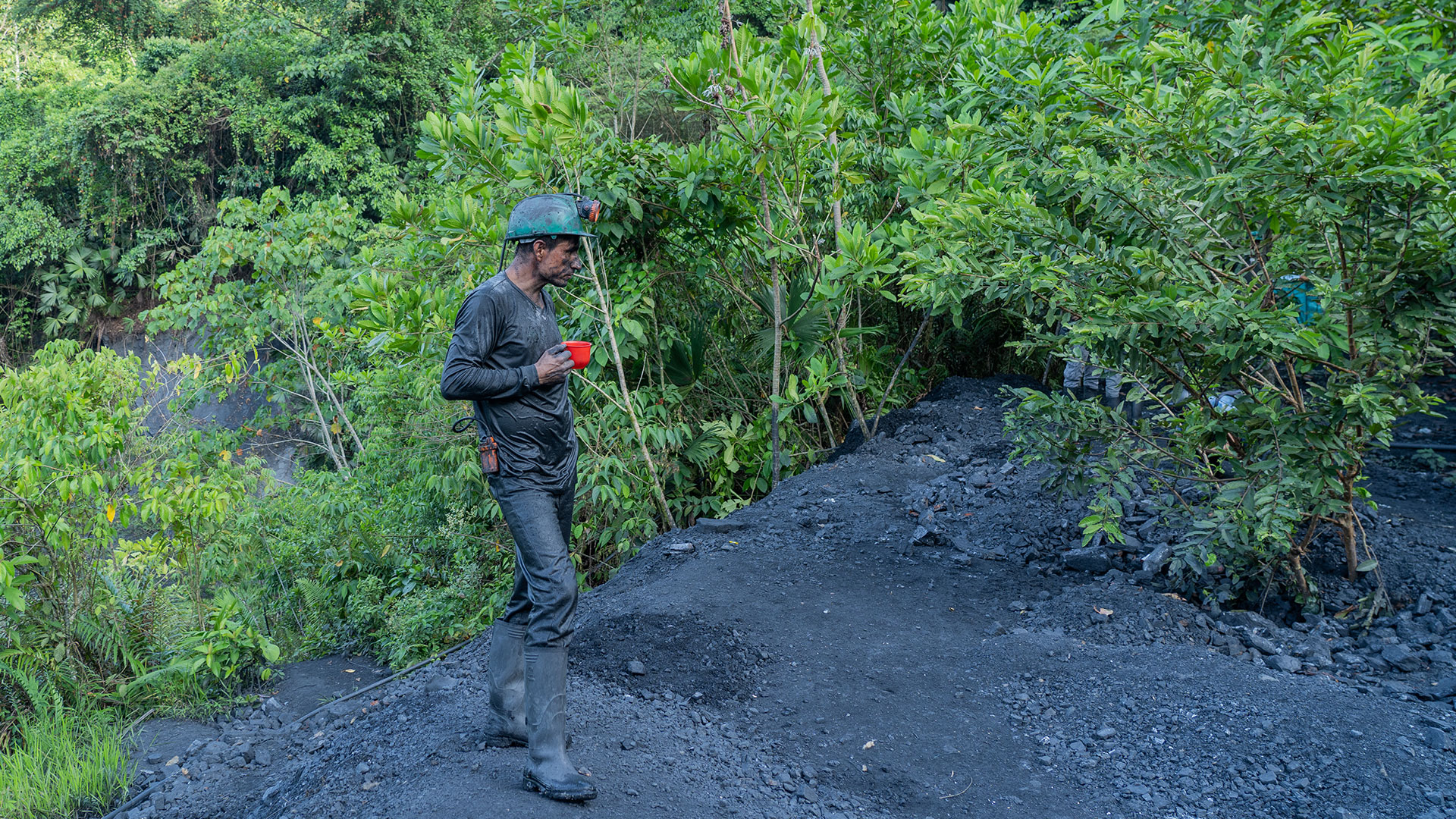
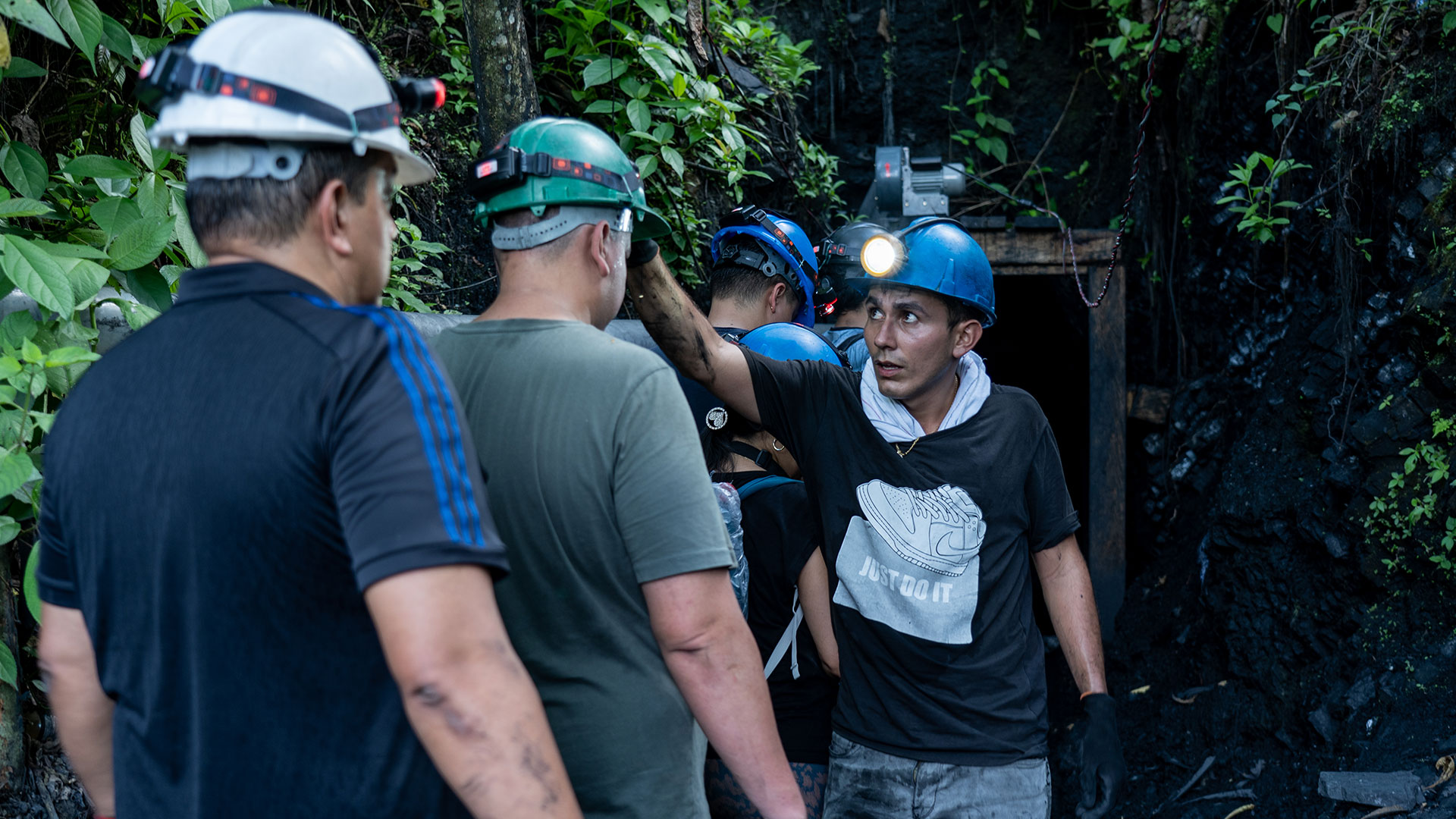


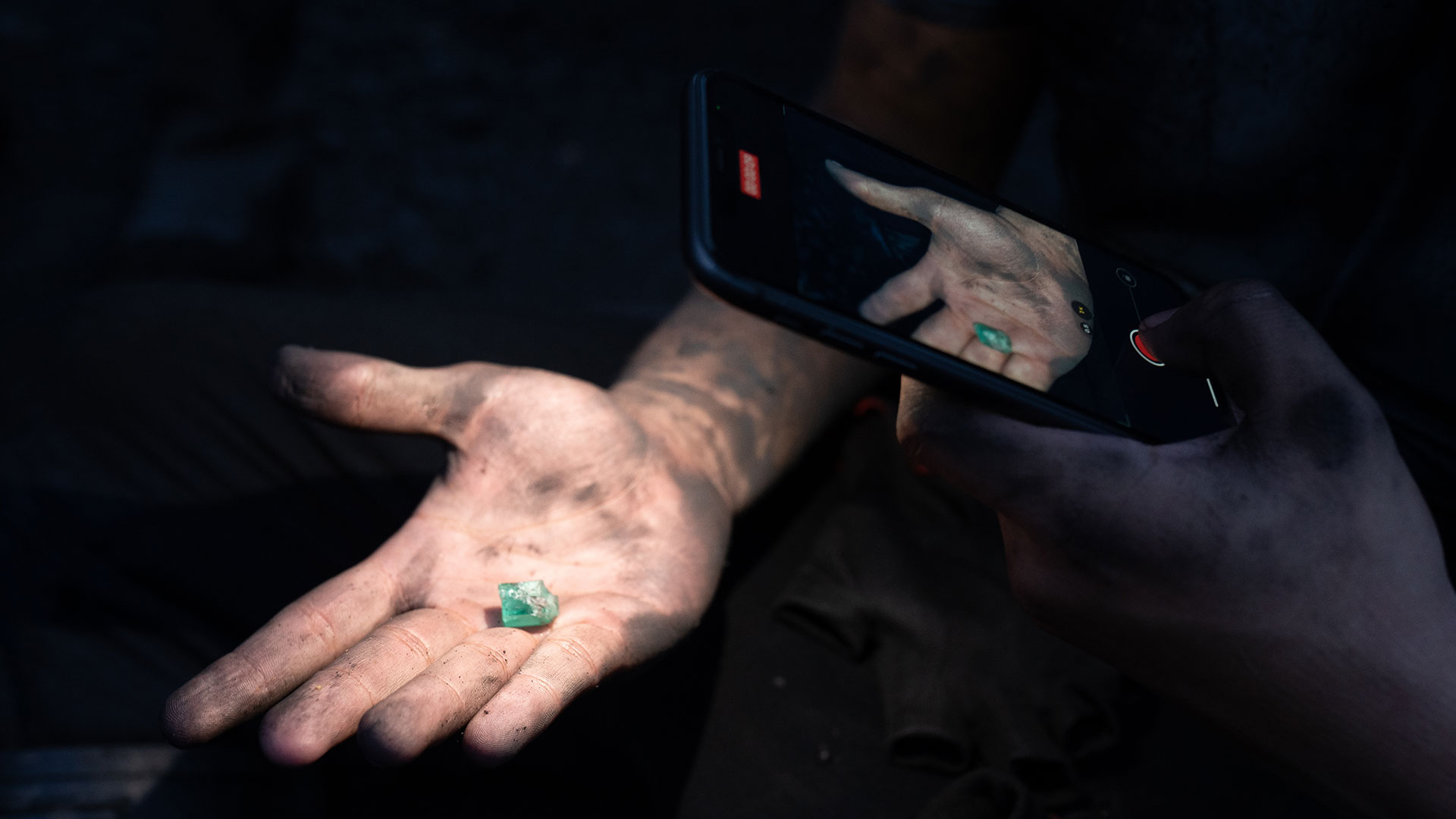
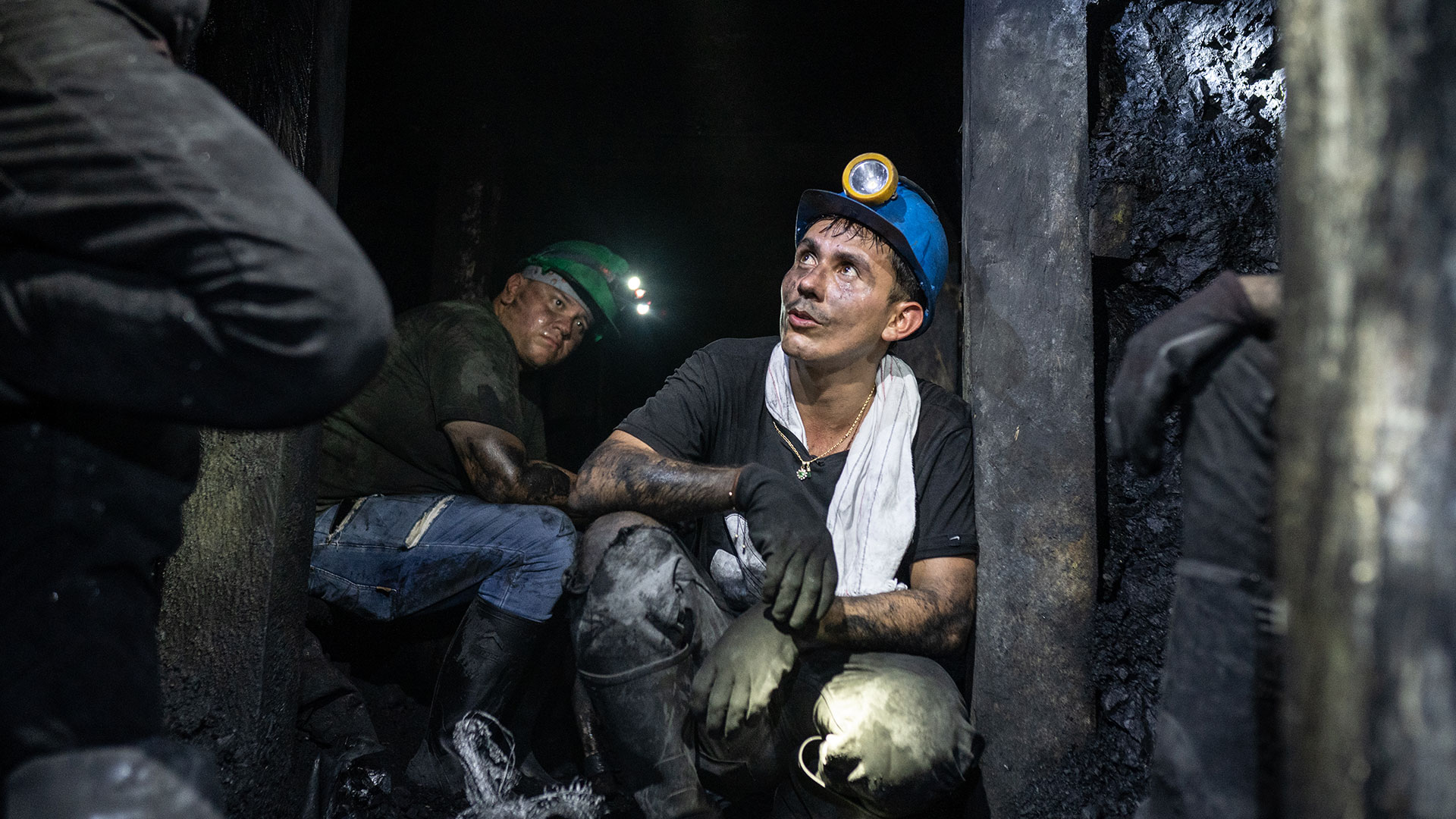

There are several holes in the ground where miners enter. The first ones you see are vertical drops several meters deep, accessed by a kind of elevator. Nearby, there’s a small shop where beer is the top seller — the drink the workers use to cool off from the heat and grueling workdays. A group gathers around five or six bottles of beer, one per miner. They play a game called tapazo: each person picks a bottle, opens it, and checks the small number on the inside of the cap. Whoever gets the lowest number pays for the round. “Everything here’s a bet. Even having a beer,” someone says.
Guaquerito makes sure the helmets’ flashlights work well before the Sánchez Nocua family enters the mine. Inside, sometimes people can walk upright; other times they have to bend down to avoid hitting their heads. Dirt carts come and go; some miners seem curious to see an outsider family subjecting themselves to the rigors of the job. The visitors get excited, sharpening their eyes so they don’t miss an emerald. The heat is intense: Josué González says there are places so hot that chisels burn your hands after just a couple of hammer blows. The family looks encouraged and uplifted by the saying that convinces miners they will soon find an emerald: “Not today, but tomorrow.”
TikTok, a window into Muzo
Weekends are the busiest days for emerald trading. Lady Fajardo sits at a small table, lays out some of the gems she has to offer, and starts a livestream on TikTok using one of her phones. On the other, she receives messages from viewers coordinating purchase details. The number of people watching varies; this time, around 130 are tuned in.
However, those watching aren’t just seeing Lady’s stones — other merchants, unfamiliar with social media, ask her to showcase their emeralds too, in exchange for a small commission if a sale closes. What started as a half-filled table soon overflows with emeralds from many others, left there openly, visible to anyone. Quick estimates suggest there’s at least 100 million pesos (around $25,000) worth of merchandise on that table. Sales aren’t guaranteed, but one thing seems certain: here, no one comes to steal.
Lady finishes her Saturday of digital sales around noon. Her face shows some frustration: there were no big deals, the internet signal is weak, and TikTok suspended her account because it mistook her activity for a gambling game. Some days are better than others — a reality that those who dig deep into the earth hoping to find an emerald also understand. A man, with pockets full of gems, ventures a piece of information without revealing its source: “Not even 10% of the region’s mines have been exploited.” Outside Muzo, that might sound like a small figure, but it means a lot in a town immersed in the uncertainty of fate.
Nearby is also the Italian Alessandro Durante, who is already considering extending his Boyacá journey for a few days:
—How does an Italian gem expert view the emerald trade in Colombia?
—The way stones are traded is the same all over the world. What happens in the Rosario Square in Bogotá, happens in India, in Pakistan... you see the same things: people on the street with stones in their hands. The market is the same all over the world.
—And the image of this dangerous country, at war?
—No, no. Maybe before. But not now. There’s a lot of tourism, so it’s not a problem. Nothing has happened to me, even at night, walking alone.
—How long have you been in Colombia?
—A month.
—And how long do you plan to stay?
—If I’m going to make money, my whole life.
Credits:
Sign up for our weekly newsletter to get more English-language news coverage from EL PAÍS USA Edition