
OECD chief calls on Spain to continue with program of reforms
Ángel Gurría describes country as the “best example of how reforms can work”
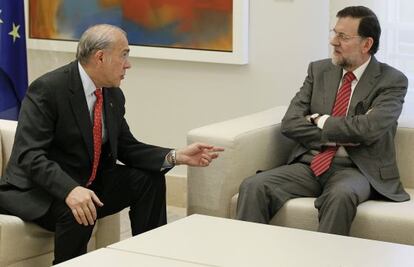
The secretary-general of the Organisation for Economic Co-operation and Development (OECD), Ángel Gurría, believes that Spain is the “best example of how reforms can work.” Speaking in an interview with EL PAÍS ahead of the presentation in Madrid of the OECD’s latest two-yearly report on Spain, the Mexican economist also warned that the pace of reform should be kept up.
The government of Spanish Prime Minister Mariano Rajoy has stated that the period of reforms and austerity measures is over, but Gurría believes that Spain should not let its guard down, even though there is, as he described it, “reform fatigue” among citizens. “Reforms are never finished, they should never be abandoned, and the most important thing to do is to reform the reforms, because they never come out well the first time,” Gurría explained. “There is always a need for adjustments.”
Reforms should never be abandoned. The most important thing to do is reform the reforms”
Gurría also argued that the time when it was better not to introduce reforms – in order to avoid upsetting sectors or unions, and thus lose popularity – was over. “A lot of reasons are put out there to avoid reforms,” he said. “These are old pretexts. These days there is a political and electoral price for not taking action. Inaction has a very high cost and is so negative that those who are not bringing about change are no longer rewarded.”
As for the reforms introduced in Spain since the economic crisis began back in 2008, the head of the OECD believes that “they were absolutely necessary,” regardless of the “color or the flavor of the party in power.” Of particular import, Gurría said, were reforms to the labor market, which have made it easier and cheaper for Spanish companies to sack workers, among other measures. “For 15 years wages were growing at a faster rate than productivity, which meant a loss of competition,” he told EL PAÍS. “There needed to be an adjustment – it’s plain arithmetic. And it was done. There are still things lacking in the labor market, but they are by-products. Above all there is a lack of skills, abilities, competition and active employment policies.”
Inaction has a very high cost. Those who don’t bring about change are no longer rewarded”
But according to Gurría, internal devaluation via salary cuts was no longer the route to take, as the OECD had recommended in a recent report. “Spain has already made the salary adjustment needed to recover competitiveness,” he said. “The current account deficit jump from a 10-percent deficit to a surplus of one percent has been enormous, and reflects improved productivity.” Now, he said, the challenge was to “change the productive model, something that is enormously complex and difficult.” The OECD believes that it is vital for Spain to improve education, build bridges between universities and the productive system and evolve toward high-technology manufacturing and services.









































