
Bailout “not essential at the moment,” says Rajoy
Spanish leader, Italy’s Monti call for speedy implementation of banking union
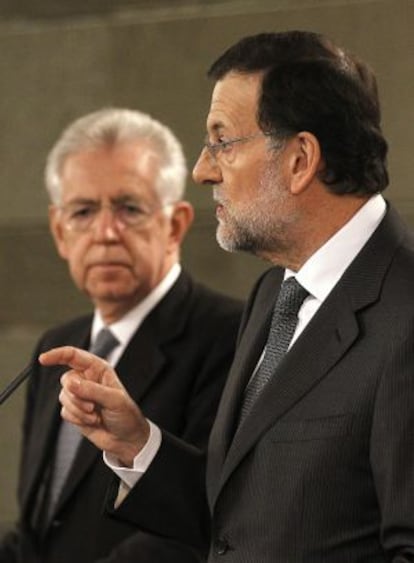
Spanish Prime Minister Mariano Rajoy continues to keep his options open on whether to seek further financial assistance from Europe, arguing on Monday that a “bailout is not essential at the moment.”
Speaking at a joint press conference in Madrid with visiting Italian Prime Minister Mario Monti, the Spanish leader said he would decide on a bailout when it is necessary and is good “for the general interest of Spaniards.”
“As soon as I think it is good for the general interests of Spain, I will ask for it, but what is important is that the instrument exists,” he said. “At this time Spain has not asked for [a bailout] because I understand that it is not essential at present for the interests of Spaniards.”
Monti also ruled out tapping the European Stability Mechanism (ESM) in order to trigger purchases of sovereign debt by the European Central Bank. “We don’t think Italy will have to set that mechanism in motion,” he said.
The encounter between Rajoy and Monti comes within the context of the first bilateral meeting between the two countries in three years. However, the two leaders have exchanged views on a number of occasions this year.
In a joint statement, Rajoy and Monti called for mechanisms that would restore lending and economic growth in Europe to be set in to motion. “We dealt with matters that don’t allow us to sleep in peace,” Monti said.
The two leaders also called for plans for a European banking union to be implemented as soon as possible, and for the direct recapitalization of banks to be in place next year.
Rajoy rejected the idea of setting up a European Commission body to oversee the budgets of the member countries of the European Union, an idea proposed by ECB President Mario Draghi. Monti also rejected the idea as “something that is not possible.”
In response to remarks by US President Barack Obama that Spain should not be allowed to go under, Rajoy said his government is carrying out reforms and implementing cutbacks to overcome the economic crisis









































