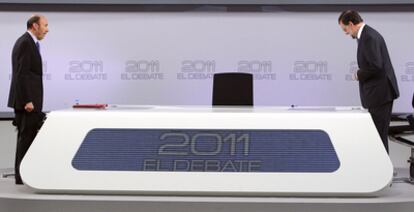
Rajoy wins TV debate after surviving Rubalcaba assault
Opposition leader sidestepped aggressive demands by Socialist to be more specific on social policies and budget cutbacks
In the only televised debate between prime ministerial candidates Mariano Rajoy of the Popular Party and Alfredo Pérez Rubalcaba, his Socialist counterpart, ahead of the November 20 general election, the conservative leader was regarded as coming off best according to the results of a flash poll conducted by Metroscopia for EL PAÍS.
Forty-six percent of the 500 people surveyed after the debate - which drew an audience of 12 million people, fewer than watched the 2008 head-to-head between Rajoy and incumbent Prime Minister José Luis Rodríguez Zapatero - said the PP leader had bettered Rubalcaba. The Socialist candidate won 41 percent of the poll, with 13 percent of respondents opining the debate had ended in a tie. Neither politician was able to unleash the full force of his personality during the contest; Rubalcaba did not and could not speak on government issues, constrained by the shadow of five million unemployed hanging over the Socialist administration, whereas Rajoy did not wish to hold forth on his party's plans for belt tightening in the case that he assumes the role of prime minister on November 20.
The PP leader has run his campaign so far largely on silence and has yet to proffer a full platform of policies. The center-right party is some 17 percentage points ahead of the Socialists in voter-intention polls, on course for an absolute majority.
The Socialist candidate, for his part, did flesh out some of the proposals of his party, such as seeking a two-year moratorium from the European Union on the application of deficit-reduction measures. But for the most part Rubalcaba centered his approach on the lack of clear policies emanating from the Popular Party, aggressively interrogating Rajoy over his exact intentions for unemployment subsidies, collective bargaining for workers in small companies, and public education and healthcare.
Rajoy, meanwhile, attacked the Socialist government's track record during the economic crisis, placing particular emphasis on the highest unemployment rate in the European Union and the freezing of pensions. Rubalcaba, Rajoy opined this morning in Melilla, had laid bare the "spent strategy of the Socialist Party to conjure images of all the evils in hell."
"The citizenry is well versed in the necessity for change," he added.
Other PP leaders regarded the debate as the final nail in the coffin of Socialist rule. Madrid regional premier Esperanza Aguirre described Rajoy as "immense" and "sensational," adding her view that "Rubalcaba and the truth are incompatible."
Soraya Sáenz de Santamaría, the PP Congressional spokeswoman said "if that was Rubalcaba's final bullet, it was barely even a pellet."
The Socialists broadly viewed the debate as a victory for Rubalcaba, largely because Rajoy did little to dispel doubts over his plans should he win on November 20. "Rajoy didn't answer a single question, he once again hid his intentions and what is even worse, he demonstrated that he doesn't even know his own electoral program," said Health Minister Leire Pajín.