The Anacé Indigenous people are protesting TikTok’s construction of the largest data center in Brazil
The native people, who fear the social and environmental impact of the project, accuse the company of not consulting them about installing multi-billion dollar infrastructure on their traditional lands
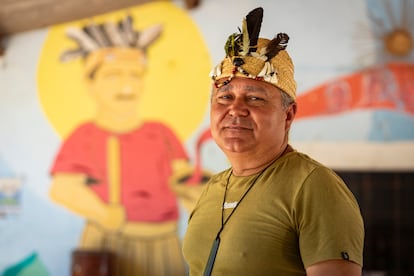

Before getting into the details, Roberto Ytaysaba, who is from Brazil, wants to make one thing perfectly clear: neither he nor the Anacé Indigenous people, whom he leads, are against progress. “We’re not against progress if it respects the communities, nature, spirituality, the autonomy of [native] peoples and Convention 169,” he clarifies, one recent morning in his village.
They’ve had electricity here since the 1980s. The school teaches ethnomathematics to the children. And, recently, the village inaugurated a clinic specifically for Indigenous people, something that’s the envy of this region in the arid northeast of Brazil.
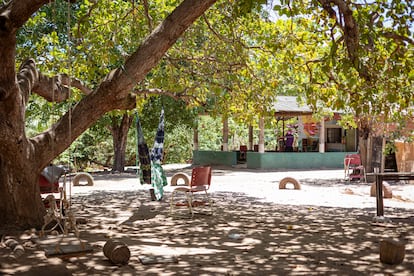
However, as so often in recent centuries, a threat looms over them. “This project is an invasion, just like the Portuguese invasion in 1500, what they called the ‘discovery,’” this Anacé chief warns. Born in 1976 in a hammock, he’s known as Chief Roberto. He elaborates on his arguments — which are seasoned with history, metaphors and irony — in the communal kitchen, which is the heart of the village. As he speaks, a pleasant breeze tempers the heat.
The traditional lands of the Anacé are located in Caucaia, a municipality which is part of the Fortaleza metropolitan area. After resisting the Portuguese here, between the 17th and 18th centuries — what the colonizers’ chronicles referred to as the “War of the Barbarians” — they now face a formidable 21st-century adversary: TikTok, one of the world’s most popular social media platforms.
This Indigenous community has launched a peaceful battle with the support of lawyers, NGOs and the Public Prosecutor’s Office against the Chinese company. They fear that the mega-data center it plans to build on land which they consider to be their own will negatively impact them. They’re also concerned because no “free, prior and informed consultation” took place, as mandated by the Indigenous and Tribal Peoples Convention of 1989 (an International Labour Organization convention, often referred to as Convention 169). Around the world, this convention is as frequently ignored by investors as it is invoked by Indigenous peoples.
ByteDance, the company that owns the social media network that has captivated hundreds of millions of internet users, has partnered with a Brazilian wind energy company, Casa dos Ventos, to build a 300-megawatt data center that will be the most powerful one in Brazil.
ByteDance “appreciates the license that has been granted [so that] TikTok can operate a data center in Brazil,” according to a statement responding to inquiries made by EL PAÍS. The firm adds: “We [are continuing our discussions] with local partners and look forward to collaborating with local communities in our commitment to sustainability, equity and transparency.”
In another statement, Casa dos Ventos notes that it “complies with all international and national conventions and regulations.”
Chief Roberto recalls that one of the first discoveries he made during this battle against the tech giant is that the cloud — the place for storing data — isn’t actually an ethereal space. Rather, it’s a physical place, one that’s located on Earth.
Like many Indigenous people in Brazil, Roberto Ytaysaba also has a Portuguese surname: Roberto Antonio Marques da Silva. The chief says that, in addition to his leadership roles, he works as a teacher and librarian at the local school, while also doing shifts as a security guard. He mentions that, after meeting his wife, he abandoned his plans to become a Catholic priest.
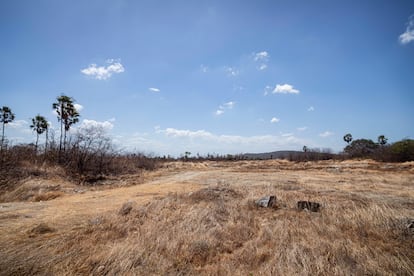
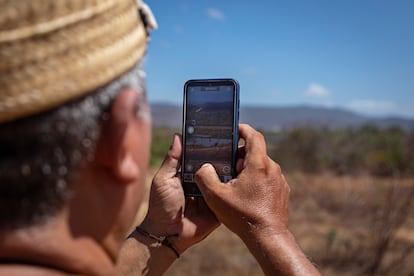
Chief Roberto grabs his helmet and rides his motorcycle a few miles, until he reaches a crossroads. On the other side, he shows EL PAÍS the field that’s apparently reserved for TikTok. It lies on what the Anacé people consider to be their traditional lands.
The plot is relatively barren, with a couple of small ponds, some trees and bushes, along with white stakes and numerous stones that gleam with silvery flashes. On the way to the site, the chief points out another encroachment… this one of a religious nature, he jokes. It’s a shrine dedicated to Saint Hedwig, erected by a local member of parliament.
Why would the firm want to place this data center in this particular spot, here in the Fortaleza metropolitan area? The answer lies at the bottom of the sea. The capital of the Brazilian state of Ceará is a major hub for the submarine cables that connect Brazil’s internet to the world.
Construction to house TikTok’s supercomputers will begin “this year or in early 2026,” according to the Brazilian company Casa dos Ventos. And “the first phase will be operational in the second half of 2027.” For now, however, nothing on the rocky site indicates that the project, which Brazilian authorities have placed great hopes in, is about to take root at this site. The government has estimated that, should it go through, the center will attract $9 billion in investment.
Brazil is campaigning to attract the growing data center industry. It aspires to become one of the international epicenters of the business. And, to that end, the country offers investors tax breaks, low costs and abundant sun and wind that, thanks to renewable energy, could power these supercomputers that operate 24 hours a day, seven days a week. “Data centers are now the heart of the digital ecosystem, driving innovation, expanding connectivity and generating jobs worldwide,” Communications Minister Frederico de Siqueira emphasized, at the inauguration of one of these projects back in October. “The expectation is to attract other centers, [in order to] strengthen digital sovereignty and expand our data storage and processing capacity,” he added. Brazil is home to nearly 200 data centers, which, according to the government, employ two million people.
The government’s interest in the TikTok project is at its peak. President Luiz Inácio Lula da Silva even met with the company’s CEO, Shou Zi Chew, at the latter’ request. This 30-minute-long meeting took place back in September, in New York City, where the Brazilian head of state was attending the UN General Assembly.
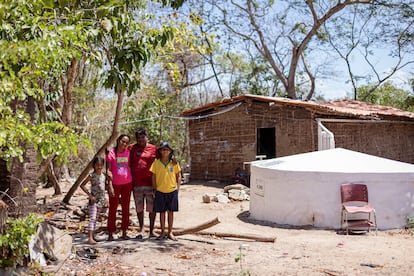
The traditional lands of the Anacé people still haven’t achieved legal recognition as an Indigenous reserve. Still, the community enjoys tacit recognition, because the authorities provide them with educational and healthcare services that are adapted to their culture.
The lack of formal recognition has been compounded by the effects of a schism, one that has a familial element. The new data center will be part of the Pecém Industrial and Port Complex. Ytaysaba explains that the reason this complex was built in the first place was because a splinter group of the Anacé agreed to cede the land (behind the chiefs’ backs), in exchange for their relocation. For this reason, the remaining Anacé, whom he leads, don’t recognize the agreements made by the dissenting relatives. Instead, they assert their right to these lands. “We want them back,” he demands. After that internal rift, these Indigenous people approved their own 26-page protocol for internal consultations.
The news that TikTok and its Brazilian partners were going to set up shop in Caucaia came to the tribe thanks to an article published by The Intercept Brazil back in May. It revealed the enormous quantities of water and energy that the project would require, while reminding readers that the city had declared a drought emergency in 16 of the last 21 years. The Indigenous people immediately set out to find allies. Natives and activists had to thoroughly research an issue about which they knew almost nothing. They soon began to mobilize in protest.
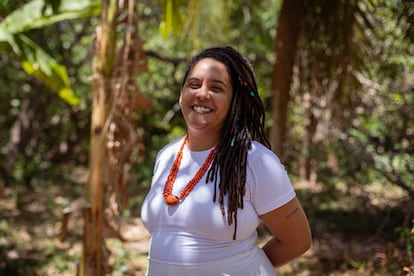
Letícia Abreu is a 32-year-old lawyer with Instituto Terramar, a local NGO. She advises the Anacé people. Sitting next to the chief, she points out the two issues that she considers to be the most contentious. Firstly, the data center project obtained its environmental license through a simplified process, without any mention of its scale. This procedure is now being investigated by the Public Prosecutor’s Office, according to Abreu.
“These data storage facilities are plugged in 24/7,” she emphasizes. “They never unplug them. They require a huge water supply… and while [the firms] say they’ll only use renewable energy, solar and wind power don’t offer a stable supply.” Casa dos Ventos states that the project will operate with “a 100% renewable energy supply.”
The underlying problem, the activist lawyer from the Terramar Institute notes, is that renewable energy projects are often strategically installed in areas inhabited by traditional or Indigenous communities, where land ownership isn’t often legally recognized. This weakens the ability of those affected to defend their rights. Abreu also emphasizes that what they’re fighting against is inequality, not renewable energy. The NGO advocates for a just energy transition.
Chief Roberto confirms that a dialogue has been established with those pushing for the data center. Still, he finds their terms to be unconvincing: “They want to come and explain the project… but for now, we haven’t authorized [this],” he explains.
“First, they violate us. And now, they’re asking us to marry them,” he scoffs.
Like the vast majority of lower-income Brazilians, the Anacé Indigenous people are well aware of their rights. And so, when the project representatives sit down with the chief and offer to improve the electricity supply or internet connection in exchange for the community’s support, he becomes furious and responds sharply: “What kind of promise is that? That’s [our] right!”
They’ve told him the data center will operate with a closed-loop water system, but he fears that the village’s wells will run dry. He’s worried about the water supply, the impact on biodiversity, the heat and noise emanating from the facilities and, above all, that this project seems destined to pave the way for similar ones down the road.
The Anacé chief is using every means at his disposal to publicize his people’s struggle. On the day of his interview with EL PAÍS, he had just returned from the city of Belém. There, he had spoken about his battle against TikTok, in a debate held alongside the UN climate summit, COP30. And that’s precisely why, he says, he has a TikTok account, just like some one hundred million of his compatriots. “I only use it to amplify our voice, not for those silly dances,” he clarifies.
Reflecting on the power of the internet, he links the contemporary addiction to social media with one of the most influential chapters in Brazilian history. “We live in an era of digital slavery. The internet is like a chain that, instead of tightening around the neck, tightens around the brain. The data center is a kind of slave ship, because we’re at the mercy of a minority that manipulates us and encourages us to buy into a false kind of happiness.”
These are the words of the chief: a teacher, librarian, security guard and Indigenous leader in Brazil, in 2025.
Translated by Avik Jain Chatlani.
Article published in collaboration with Luminate
Sign up for our weekly newsletter to get more English-language news coverage from EL PAÍS USA Edition
Tu suscripción se está usando en otro dispositivo
¿Quieres añadir otro usuario a tu suscripción?
Si continúas leyendo en este dispositivo, no se podrá leer en el otro.
FlechaTu suscripción se está usando en otro dispositivo y solo puedes acceder a EL PAÍS desde un dispositivo a la vez.
Si quieres compartir tu cuenta, cambia tu suscripción a la modalidad Premium, así podrás añadir otro usuario. Cada uno accederá con su propia cuenta de email, lo que os permitirá personalizar vuestra experiencia en EL PAÍS.
¿Tienes una suscripción de empresa? Accede aquí para contratar más cuentas.
En el caso de no saber quién está usando tu cuenta, te recomendamos cambiar tu contraseña aquí.
Si decides continuar compartiendo tu cuenta, este mensaje se mostrará en tu dispositivo y en el de la otra persona que está usando tu cuenta de forma indefinida, afectando a tu experiencia de lectura. Puedes consultar aquí los términos y condiciones de la suscripción digital.